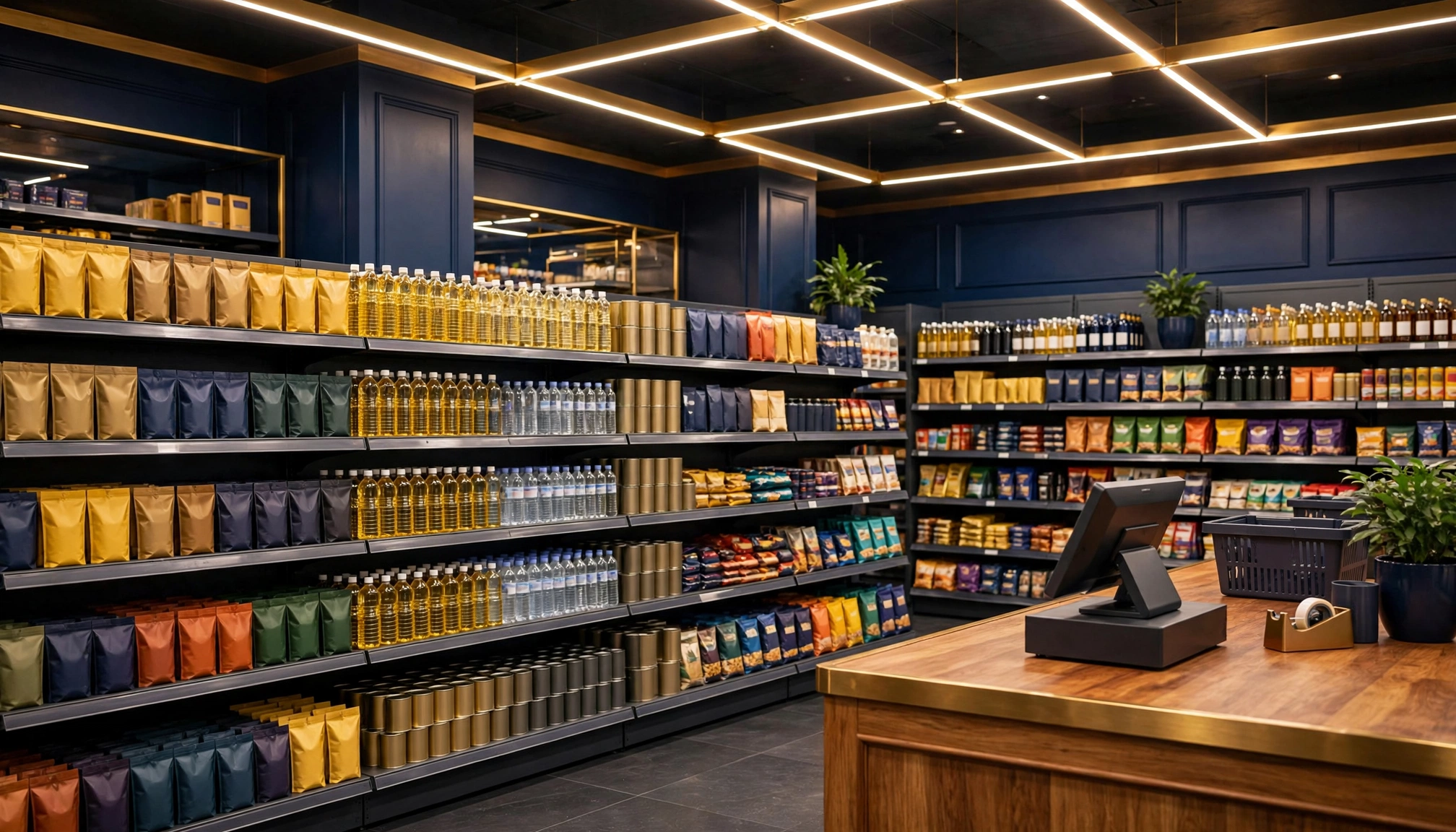
Cost to Open a Mini Supermarket in Nigeria: Startup & Running Expenses
SwiftPOS Team
Published July 07, 2026

Dreaming of opening a mini supermarket in Nigeria but worried about the financial labyrinth? You're not alone. Many aspiring entrepreneurs grapple with the daunting question of "how much to open a supermarket," often underestimating the true cost and complexity involved. The fear of hidden expenses and the struggle to accurately project profitability can stifle even the most promising ventures.
The Hidden Costs of Manual Retail Management
Operating a mini supermarket or provision store in Nigeria is a dynamic endeavor, but relying on outdated methods like paper ledgers or basic spreadsheets can quickly turn your dream into a nightmare. Without a robust system, managing your retail operations becomes a constant battle against inefficiency and financial obscurity.
Many small-to-medium retail businesses face significant challenges that directly impact their profitability and growth potential. According to a report by Accenture, businesses that leverage digital tools for operations can see up to a 15% increase in operational efficiency and significant cost savings. Conversely, those stuck in manual processes often contend with:
- Inventory Discrepancies and Stockouts: Manually tracking hundreds or thousands of products leads to frequent errors. This results in either overstocking (tying up capital) or understocking (missing sales opportunities). Imagine a customer walking out because your popular item is unavailable, simply because you didn't know it was time to reorder.
- Inaccurate Sales Data and Lost Revenue: Without a proper point-of-sale (POS) system, every transaction recorded on paper or in a basic Excel sheet is prone to human error, theft, or miscalculation. This leads to an unclear picture of daily sales, difficulty identifying best-selling products, and ultimately, lost revenue that could be prevented. A study by IHL Group found that retailers lose an estimated $1.75 trillion annually due to out-of-stocks, overstocks, and returns – issues often exacerbated by poor inventory management.
- Time-Consuming Reporting and Lack of Insights: Compiling daily, weekly, or monthly sales reports manually is a laborious task that takes valuable time away from strategic business development. Business owners are often left guessing about their profit margins, identifying peak sales hours, or understanding customer purchasing patterns. This lack of real-time, actionable insights means missed opportunities for growth and optimization.
- Difficulty in Managing Multiple Branches: For those looking to expand beyond a single provision store, managing inventory, sales, and staff across multiple locations using manual methods is nearly impossible. Consistency in pricing, stock levels, and reporting becomes a monumental challenge, hindering scalable growth.
 A frustrated small business owner looking at stacks of paper ledgers and a complex, disorganized Excel sheet, surrounded by overflowing inventory shelves.
The True Cost Breakdown: Beyond the Obvious
Understanding the cost to open a mini supermarket in Nigeria requires a holistic view, encompassing both initial setup and ongoing operational expenses. Many entrepreneurs focus solely on rent and initial stock, overlooking critical components that can make or break their business.
Startup Costs (Initial Investment)
- Shop Space Acquisition:
- Rent/Lease: This is often the largest upfront cost. Depending on the location (e.g., bustling Lagos street vs. a quieter neighborhood in Abuja), a year's rent can range from ₦500,000 to ₦5,000,000+. Expect to pay 1-2 years upfront, plus legal fees and agency commissions.
- Renovation & Fit-out: Shelving, counters, flooring, lighting, painting, and security installations (CCTV, burglar bars) are crucial. This can cost anywhere from ₦1,000,000 to ₦3,000,000+, depending on the desired aesthetic and functionality.
- Initial Inventory:
- Stock Purchase: This is your core product. A good starting inventory for a mini supermarket could require ₦2,000,000 to ₦5,000,000+, depending on the variety and quantity of goods. It's vital to have enough stock to meet initial demand without over-committing capital.
- Equipment:
- POS Hardware: While SwiftPOS NG is web-based, you'll still need a device to run it. A desktop computer, tablet, or smartphone can serve as your POS terminal. You might also need a barcode scanner and a thermal receipt printer.
- Computer/Tablet: ₦100,000 - ₦300,000
- Barcode Scanner: ₦30,000 - ₦70,000
- Thermal Printer: ₦25,000 - ₦60,000
- Refrigeration/Freezers: Essential for perishable goods. ₦150,000 - ₦500,000+ per unit.
- Generator/Inverter: Reliable power is non-negotiable in Nigeria. ₦200,000 - ₦1,000,000+.
- Air Conditioning: For customer comfort and product preservation. ₦100,000 - ₦300,000.
- Legal & Regulatory:
- Business Registration: Corporate Affairs Commission (CAC) registration. ₦50,000 - ₦100,000.
- Permits & Licenses: Local government permits, health permits, environmental permits. These vary by state and local council but can cumulatively range from ₦100,000 to ₦500,000 annually.
- Marketing & Branding:
- Signage: Shop front sign, internal branding. ₦50,000 - ₦200,000.
- Initial Promotions: Flyers, grand opening events. ₦50,000 - ₦150,000.
Operational Costs (Ongoing Expenses)
- Staff Salaries:
- Depending on the size of your mini supermarket, you might need cashiers, stock assistants, and a manager. Salaries typically range from ₦40,000 to ₦100,000+ per staff member per month.
- Utilities:
- Electricity, water, waste disposal. ₦50,000 - ₦200,000+ per month.
- Restocking Inventory:
- Ongoing purchases to maintain stock levels. This will be your largest recurring expense, fluctuating with sales.
- Transportation/Logistics: Costs associated with bringing goods from suppliers.
- Internet & Communication:
- Reliable internet is crucial for POS operations and communication. ₦15,000 - ₦30,000 per month.
- Maintenance & Repairs:
- Unexpected equipment breakdowns, general upkeep. Budget ₦20,000 - ₦50,000 per month.
- Security:
- If you hire security personnel or subscribe to a security service. ₦30,000 - ₦80,000 per month.
- Software Subscriptions:
- This is where modern solutions like SwiftPOS NG come in. Instead of hefty upfront software purchases, you pay a regular, affordable subscription fee that covers all your operational needs.
Considering these factors, a realistic estimate for the initial setup of a mini supermarket in Nigeria can range from ₦5,000,000 to ₦15,000,000, with monthly operational costs of ₦500,000 to ₦1,500,000+. These figures highlight the necessity of meticulous planning and efficient management from day one.
SwiftPOS NG: Your Ally in Smart Retail Management
Navigating the complexities of opening and running a profitable supermarket business doesn't have to be overwhelming. SwiftPOS NG is designed to streamline your operations, reduce costs, and provide the insights you need to thrive in the competitive Nigerian retail market. It’s a comprehensive, web-based Point-of-Sale (POS) management system that empowers small-to-medium retail businesses to manage their entire operation end-to-end.
SwiftPOS NG is not just a sales terminal; it's a complete retail management ecosystem. From ringing up sales to tracking inventory, generating profit-and-loss reports, managing suppliers, and viewing AI-powered business insights, it covers every aspect of your business. The platform is accessible via a web browser on any device, meaning no expensive hardware installation is required, which significantly reduces your initial setup costs.
How SwiftPOS NG Addresses Your Pain Points:
- Precise Inventory Management:
- Problem: Manual tracking leads to stockouts and overstocking.
- SwiftPOS NG Solution: Our robust inventory management system provides real-time stock levels. Features like Product Management (F15) allow you to track every item with details like SKU, barcode, category, and minimum stock levels. The Stock Forecast (F53) feature uses AI to predict average daily sales, days to stockout, and recommends restock quantities, ensuring you always have the right products at the right time. You can easily manage Product Variants (F17) and even Product Bundles (F18).
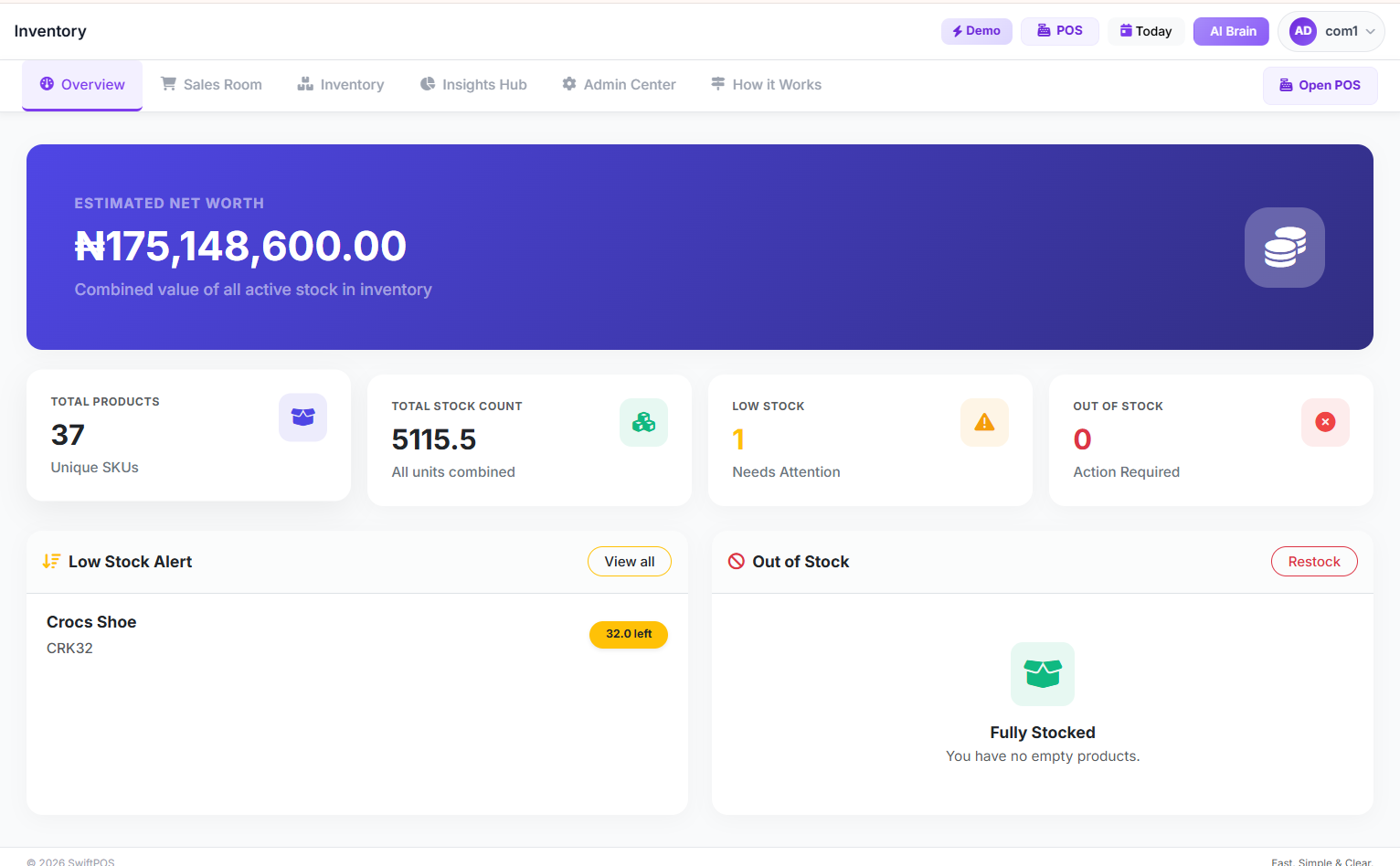 A screenshot of the SwiftPOS NG Inventory Dashboard showing real-time stock levels, low-stock alerts, and inventory value.
- Accurate Sales and Financial Reporting:
- Problem: Inaccurate sales data and opaque financial performance.
- SwiftPOS NG Solution: Every transaction is digitally recorded, eliminating human error. The Daily Sales Dashboard (F28) gives you an immediate overview of revenue, transactions, and top products. Dive deeper with the Profit and Loss Report (F33) to understand your gross profit, operating expenses, and net profit with clarity. Our Transaction History (F30) is searchable and filterable, giving you complete visibility into every sale.
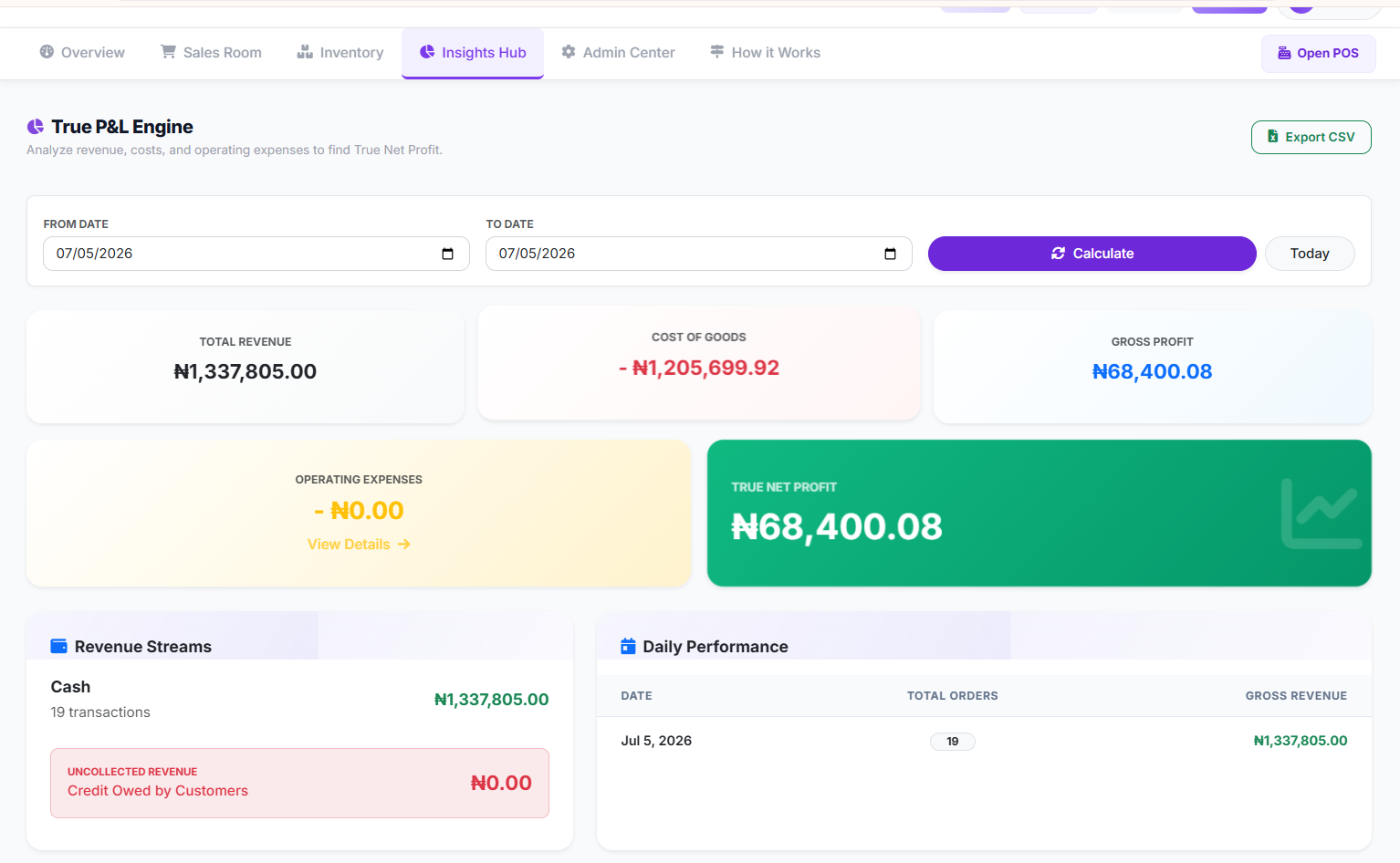 A screenshot of the SwiftPOS NG Profit and Loss Report showing detailed revenue, COGS, gross profit, and net profit figures.
- Actionable Business Insights:
- Problem: Lack of data-driven decision-making.
- SwiftPOS NG Solution: Beyond basic reports, our platform offers an AI Insights Dashboard (F51) that auto-generates actionable insights on sales, inventory, and customers. This intelligence helps you make informed decisions, optimize pricing, and identify growth opportunities. The Staff Performance Dashboard (F34) also helps you monitor employee efficiency.
- Seamless Multi-Branch Management:
- Problem: Scaling to multiple locations is a logistical nightmare.
- SwiftPOS NG Solution: SwiftPOS NG supports Multi-Branch Management (F47-F50), allowing you to oversee all your locations from a single dashboard. Track Branch-Level Stock (F48), filter reports by branch, and manage staff across different stores effortlessly. This feature is crucial for any supermarket looking to expand its footprint.
- Cost-Effective POS Operations:
- Problem: High upfront costs for traditional POS hardware and software.
- SwiftPOS NG Solution: As a web-based SaaS, SwiftPOS NG requires minimal hardware. You can use existing devices like a tablet or computer. Our subscription model means predictable, affordable monthly costs, making it easier to manage your budget. Check out our transparent pricing plans to see what fits your business.
"Switching to SwiftPOS NG transformed our mini supermarket. We moved from chaotic paper records to precise inventory control and clear financial insights. It's like having a business consultant built right into our POS system."
>
 A modern, well-organized mini supermarket interior with neatly stocked shelves, a clean checkout counter, and a cashier efficiently using a tablet-based POS system, displaying the SwiftPOS NG interface.
Proof & Comparison: SwiftPOS NG vs. Traditional Methods
| Feature/Aspect | Traditional Methods (Paper/Excel) | Manual Systems (Basic POS) | SwiftPOS NG |
|---|---|---|---|
| Initial Cost | Very Low (cost of ledgers, pens) | Moderate (basic POS software license, hardware purchase) | Low (subscription-based, uses existing hardware like tablets/laptops) |
| Inventory Tracking | Error-prone, time-consuming, prone to stockouts/overstocking | Basic tracking, often requires manual updates, limited insights | Real-time, AI-powered Stock Forecast (F53), Stock Adjustments (F19), Barcode Centre (F20) |
| Sales Reporting | Manual calculation, delayed, prone to errors, no deep insights | Basic sales summaries, often not customizable or integrated | Daily Sales Dashboard (F28), Profit and Loss Report (F33), Sales by Item Report (F32), Exportable Data |
| Financial Insights | Virtually none, guesswork | Limited to sales totals | AI Insights Dashboard (F51), comprehensive P&L, expense tracking (F56) |
| Multi-Branch Mgmt. | Extremely difficult, inconsistent data, high overhead | Often requires separate systems per branch, complex data consolidation | Integrated Multi-Branch Setup (F47), centralized control, branch-scoped reports (F50) |
| Customer Mgmt. | Basic contact notes, no purchase history | Simple customer profiles, limited interaction history | Customer Registry (F44), detailed purchase history, credit tracking (F43) |
| Error Reduction | High potential for human error | Moderate potential for human error | Automated processes, PIN Verification (F69), Audit Log (F71), Suspicious Activity Detection (F35) |
| Scalability | Very poor, cannot handle growth | Limited, often requires costly upgrades or new systems | Highly scalable, supports unlimited products, transactions, and branches |
| Accessibility | Physical records only | Tied to specific hardware/location | Web-based (any device, anywhere), Offline Order Support (F13) |
| Security | Prone to physical damage, loss, or theft | Basic password protection | Staff 2FA Login (F68), Audit Log (F71), IP Login Rate Limiting (F87), HTTPS Enforcement (F90) |
| Support | None | Vendor-dependent, often extra cost | Dedicated customer support, tutorials and resources |
How It Works: Getting Started with SwiftPOS NG
Adopting SwiftPOS NG for your mini supermarket is designed to be straightforward and hassle-free. Our goal is to get you up and running quickly, so you can focus on what matters most: growing your business.
- Sign Up for an Account: Visit our website and click on the "Sign Up" button. You'll register your company and automatically begin a trial period. This lets you explore the full functionality of SwiftPOS NG without immediate commitment.
- Set Up Your Shop:
- Add Products: Easily input your product details, including name, SKU, price, cost, and initial stock. You can even generate and print barcodes using our Barcode Centre (F20). For larger inventories, use the Bulk Product Import (F23) feature by uploading an Excel template.
- Configure Settings: Customize your company settings, currency, tax, receipt text, and even theme colors to match your brand using Company Settings (F73).
- Add Staff: Create accounts for your cashiers, managers, and other staff, assigning them appropriate roles and permissions using User Management (F72) and the Role Permissions Manager (F54).
- Start Selling:
- Use our intuitive Classic POS (F01) or Smart Grid POS (F02) interface on your tablet, laptop, or desktop. Connect a barcode scanner for faster checkout with Barcode Scanner POS (F03).
- Process sales using multiple payment methods, including cash, bank transfer, or card. Handle Split Payments (F05) and track Credit Sales (F06) seamlessly.
- Monitor & Grow:
- Regularly check your Daily Sales Dashboard (F28) and Inventory Dashboard for real-time performance.
- Leverage the AI Insights Dashboard (F51) and Stock Forecast (F53) to make informed decisions about purchasing, promotions, and operations.
- Generate comprehensive Profit and Loss Reports (F33) to understand your financial health.
Frequently Asked Questions
Q1: Is SwiftPOS NG only for large supermarkets, or can a small provision store use it?
A: SwiftPOS NG is explicitly designed for small-to-medium retail businesses, including mini supermarkets, provision stores, pharmacies, boutiques, and more. Our flexible pricing plans cater to businesses of all sizes, ensuring you only pay for the features you need as you grow.
Q2: Do I need special hardware to use SwiftPOS NG?
A: No, you do not. SwiftPOS NG is a web-based system, meaning it runs directly in your web browser. You can use any existing device such as a laptop, desktop computer, or even a tablet or smartphone as your POS terminal. While a barcode scanner and thermal printer can enhance efficiency, they are optional and easily integrated.
Q3: What if my internet connection is unreliable? Can I still make sales?
A: Yes, SwiftPOS NG includes Offline Order Support (F13). This feature allows your cashiers to continue processing sales even when the internet connection is lost. Once connectivity is restored, all transactions are automatically synced, ensuring no data is lost and your business operations remain uninterrupted.
Q4: How does SwiftPOS NG help me manage my inventory effectively and avoid stockouts?
A: SwiftPOS NG offers advanced inventory management features. The Stock Forecast (F53) dashboard uses sales data to predict when products will run low and suggests optimal restock quantities. You can set minimum stock levels, receive real-time Notifications Panel (F52) for low-stock alerts, and easily track stock movements with the Inventory Transaction Log (F21), preventing both stockouts and overstocking.
Q5: How secure is my business data with SwiftPOS NG?
A: Data security is a top priority for SwiftPOS NG. We implement robust security measures including Staff 2FA Login (F68) for enhanced user authentication, an Audit Log (F71) that tracks all user actions, IP Login Rate Limiting (F87), and HTTPS Enforcement (F90) to protect data in transit. Your business data is isolated and secured using a multi-tenancy model, ensuring your information remains private and protected.
Ready to Transform Your Supermarket Business?
Stop letting manual processes and hidden costs hinder your mini supermarket's potential. SwiftPOS NG offers the tools and insights you need to manage your retail operations efficiently, profitably, and with confidence. Take the first step towards smarter retail management today. Explore our features and see how SwiftPOS NG can empower your business.
To get started, simply visit our main application at app.swiftpos.ng or download the SwiftPOS Android Application to manage your retail shop using AI and valuable insights.
For more information, feel free to reach out to us via our contact page.
Contact Details & WhatsApp: +2349164601810

How to Know If Your Business Is Actually Profitable: A…
Oct 08, 2026
How to Stop Cash Leakage in Your Business: A Comprehen…
Oct 04, 2026
How to Start a Food Business with Low Capital: A Step-…
Oct 01, 2026